Put two pendants side by side under a showroom light. Both carry VVS1, D-color moissanite. Both are listed as 925 sterling silver. One reads crisp and bright from across the room. The other looks busy: a few stones sit higher than their neighbors, the metal crowds the edges, and the outline looks soft. Nothing on either spec sheet explains the difference.
Samuel Madrid built Miami The Jeweler around that gap. His downtown Miami shop sells premium moissanite set in sterling silver, along with natural and lab-grown diamonds set in solid gold. His working position is simple to state and hard to execute: a gem grade describes one ingredient, and the customer wears the finished piece.
A grade covers the stone and stops there
Gem grades tell you something real. VVS1 clarity means any inclusions are extremely difficult to see even under 10x magnification. D sits at the colorless top of the color scale the diamond trade uses, and moissanite sellers borrow the same vocabulary. Moissanite itself is a distinct gemstone, silicon carbide, with a higher refractive index and greater dispersion than diamond.
All of that describes a loose stone before anyone sets it. A grade says nothing about the prongs, the spacing, the links that carry the stones, the clasp or the finish on the metal. A buyer reading a listing gets the stone’s resume and very little about the work that turns stones into jewelry.
Setting decides how the stone reads
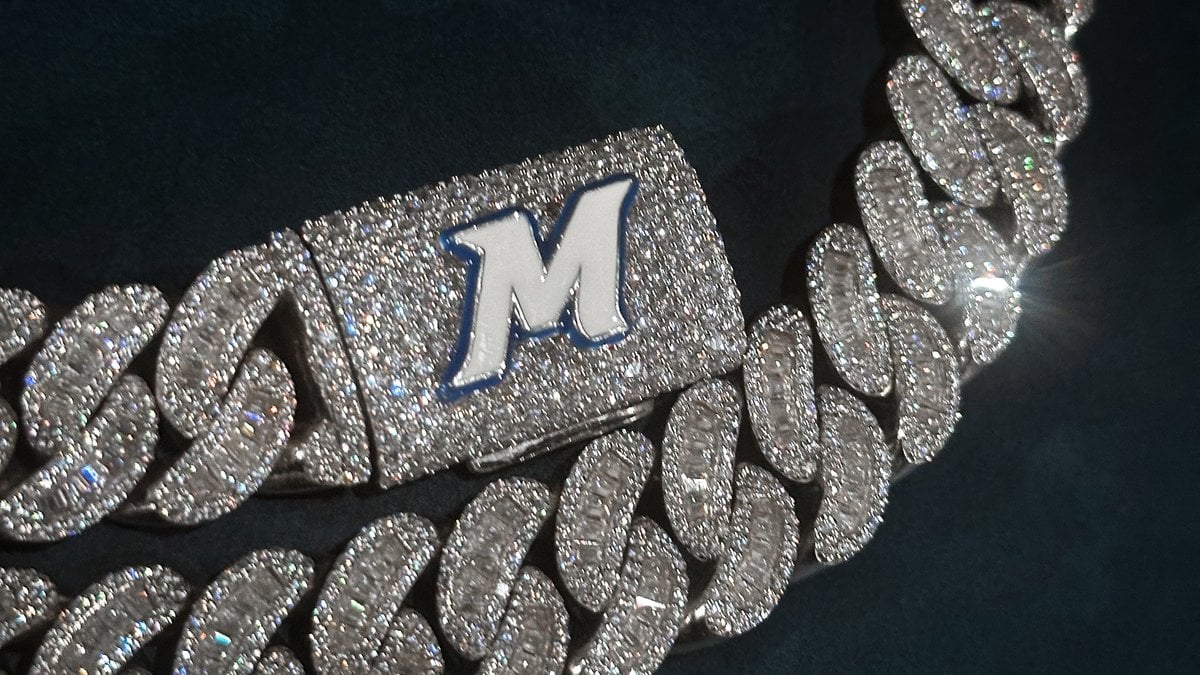
The setting is the first place a good stone can be helped or wasted. Miami The Jeweler focuses on precise setting with small, clean prongs: enough metal to hold each stone securely, without letting that metal dominate the stone. Stones should sit level, at consistent heights, facing the same direction. If one stone tilts, it catches light at a different angle than the stones around it, and your eye goes straight to it.
Spacing works the same way. Even gaps let a row of stones read as one continuous line of light. Uneven gaps break that line into segments, and on a long piece the breaks add up.
Structure decides how the piece wears
Proportion, weight and construction determine whether a chain drapes or kinks, whether a pendant hangs straight or flips around, and whether a bracelet sits comfortably on the wrist. MTJ counts substantial construction and appropriate weight as part of quality. A piece should feel solid in the hand and move the way its design intends.
Clasps and other working parts belong here too. A clasp that closes loosely, or a jump ring that opens under strain, can cost an owner the whole piece. Those components barely show up in product photos, and they carry the full load of daily wear.
Finish and inspection close the loop
Finishing covers polish, edges and, on yellow-finish moissanite pieces, the 18K gold plating over 925 sterling silver. Careful finishing removes sharp edges, evens out surfaces and gives the plating a clean base. Plating still wears with friction, chemicals and skin contact over time, so good finishing extends a piece’s looks without making them permanent.
The last step is inspection of the completed piece, and MTJ’s rule there leaves no room for negotiation. If a piece does not meet the top standard, the team melts it down and starts over. Madrid explains the logic in one line: “Everything we do has to be perfect, otherwise it’s not ready for our customers.”
Lower material cost, same standard
Moissanite and sterling silver cost less than natural diamonds and solid gold. The quality of moissanite jewelry varies considerably depending on stone selection, materials, setting and quality control, and a lower material cost can tempt a maker to treat the work around the stone as an afterthought. MTJ’s position runs the other way: the material should never be an excuse for poor craftsmanship.
The physical properties support that view. Moissanite rates about 9.25 on the Mohs hardness scale against diamond’s 10, which puts it among the hardest gemstones used in jewelry and makes it durable enough for everyday wear with proper care. A stone that hard deserves a setting built to last as long as it does. In MTJ’s experience, the finished result depends on everything that happens after the stone is chosen.
The diamond side of the business runs on the same rule. A natural or lab-grown diamond set in solid 10K, 14K or 18K gold gets the same attention to prongs, alignment and clasps. The shop’s shorthand for this is different materials, same obsession with quality.
What you can check yourself
Most of this is visible to a buyer without tools. Look at a stone-set piece in daylight and tilt it back and forth. Check that the stones sit level and the gaps look even. Study the prongs from the side; they should match in size and shape. Lift the piece and feel its weight. Open and close the clasp several times. Then ask the seller to state the metal plainly, including whether a yellow finish is plating or solid gold.
Miami The Jeweler’s showroom is at 22 NE First St, Suite 225, in downtown Miami, and the shop’s collections are online for anyone who wants to compare before visiting.