As the world can be a scary, messy place, our homes are our safe havens where we go to unwind and relax as we hide away from the havoc. Still, as it happens, many of us fail to notice that more often than not the interior décor lacks the harmony we crave.
This became apparent for most of us especially last year when due to the global COVID-19 pandemic we found ourselves spending increasingly more time at home. If you find this to be you, and you’re in need of change, you could resort to unifying two distinct rooms with a seamless flow.
Want an example? The bedroom with the bathroom! It’s a solution that’s sure to provide you with a cohesive outcome, the kind you expect to see on the pages of inspirational home décor magazines and amazing shows like Fixer Upper. It might sound easier said than done, but here are some steps you can take to make the most of the project.
Pay Attention to the Style
What you can expect to accomplish with such a décor scheme is harmonious transitioning from one room to the other. This would give you the visual effect of seeing the home as a whole, instead of finding a room to be an eyesore – seeming detached by differing from the rest.
One of the basic ways to achieve this desired flow is to carefully choose the style of the bathroom fittings and accessories and the bedroom furniture. If you’re up for a modern feel, then it’s important to invite furnishings that feature clean and sleek lines. In case you care about avoiding a matchy matchy look, perhaps you’d be up for mixing it up with an eclectic outcome by introducing some elements in a different style.
Just be sure to mirror it in both the bedroom and bathroom. Now, let’s say you pick out modern vanity and cabinetry for the bathroom, and you mix things up with vintage hardware and tapware. How to proceed?
Well, the key to creating continuity lies in doing the same with the bedroom by choosing modern side tables and adding a touch of the vintage charm with the hardware, for example, in the form of ornate knobs. The door hardware is important here too, so feel free to use it in your project too. All in all, this kind of eclectic scheme is much better than opting for eclectic decorating on a large scale i.e., using a different style for every room.
Lay the Foundation with Colours
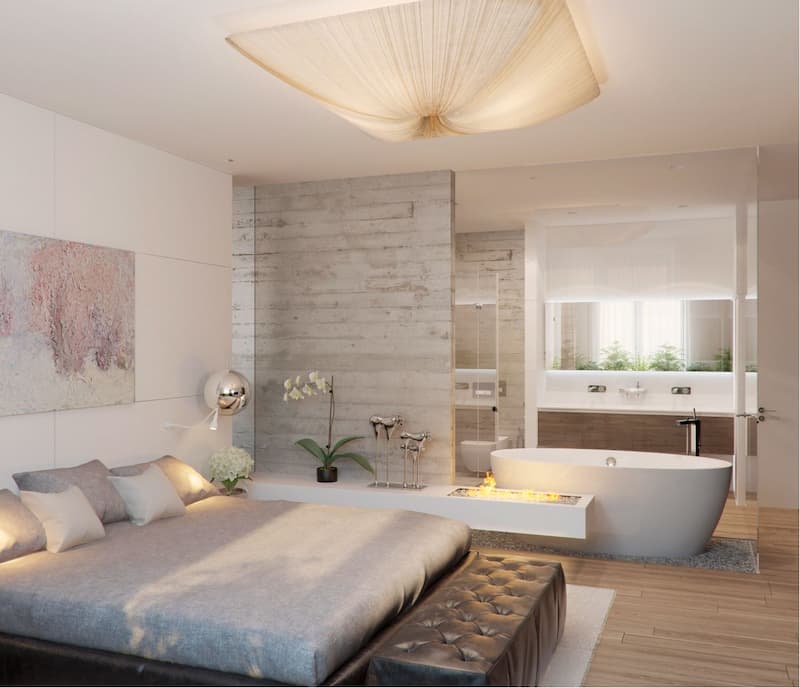
For one, you could achieve this unity by choosing the same tones for the walls and floors. In case you pick white walls, and grey vinyl flooring, and you want to reinforce the harmony of the two, you can do so by buying ultra stylish bathroom fittings and accessories of the same colours, that also match those of the bedroom.
Or, you’ve got the option to break away from monotony by introducing furnishings in different colours; how do you like the sound of earth-toned brown for the vanity and bed frame? This would allow you to further treat the two spaces as one!
You can enhance the feel by introducing other elements like furniture pieces and accessories that match this brown. Yes, it’s okay to repeat the basic colours of your choice! The bathroom mirror frame, the shower niche as a key ingredient of organising the bathroom and maximising storage space, the bedside shelving and the wardrobe are all examples of what you can include in your decorating game.
If you fear this would give off too modern of a feel, due to the combination of white and the grey to the side of transmitting too much coolness, pick out one warm colour to add an eye-pleasing contrast. Besides the stylish bathroom supplies, you can use textures from fabrics to your advantage when it comes to this.
For instance, soft pink for the bedding, throw blankets, rugs, curtains, towels and mats can help you spice things up in the bedroom and bathroom. Not that fond of this kind of softness? Why not welcome calming green! Plants, and greenery as a whole are other elements you can use to break away from the base colours making for a fresh result without overbearing the décor.
Even if you aren’t too proud as a plant parent, it’s easier than ever before to care for plants when you’ve got the help of a self-watering planter which can become part of the decorative scheme too. As the urban gardening solution, they make great additions in the bedroom as much as the bathroom, and you can choose from designs fit for the floor or those you can hang on the ceiling.
Create a Connection with Materials

The same goes for the lighting fixtures, and their finishes, much like the bathroom tapware and the bedroom hardware. Should you choose a metallic finish for the one room, it’s a must-have for the other too! Have in mind, if stainless steel is your primary choice for the bathroom fittings, you’d create a visual mess deciding to invite brass in the bedroom.
Lastly, the flooring. When choosing to create a flow among these rooms, think of the project similar to the open floor plan living – you get the harmony by repeating the same colour and material with the floor. Hardwood flooring is a top pick if you care about durability and strength, though when it comes to maintenance vinyl is an all-in-one choice that turns out to be a better option for other reasons too – it’s also more affordable, and versatile, and suitable for the bathroom as a humid environment.
If you choose to cover up the floors with textiles, again the key is in repeating them in both rooms. Even if you don’t think you could match the fluff of the bedroom rug with that of the bathroom, out of reasons such as cleanliness and maintenance, you could still make use of this kind of rug in this room – it just takes a little creativity. Why not add a dose of charm to the toilet by covering up the tank cover with a matching rug?